
Why elite rowers train by watts
Split time flatters slow efforts and hides how much a fast one really costs. Watts measure the actual work in every stroke.

You drop your split by two seconds. It feels the same as the last two seconds you dropped, and the two before that. It isn’t, and on the erg almost nobody notices.
Split time is the number every rowing machine puts front and centre: pace per 500 metres, easy to read, easy to chase. But it’s a derived number, calculated from your speed, not a direct measure of the effort producing it. Watts, the metric elite rowers actually train by, measure power output directly: the real work you’re putting into the flywheel on every stroke. The gap between those two numbers isn’t trivia. It changes how honestly you can read your own progress.
The number that flatters you
Split time and effort don’t move together. Shave two seconds off a lazy 2:30 split and you’ve added a modest amount of power. Shave the same two seconds off a 1:32 and you’re asking your body for a disproportionate jump. The relationship isn’t a straight line. It curves, and it curves hardest right when you’re already working hardest.
It’s the same trick a car’s speedometer plays on a hill. Hold 80 km/h on the flat and the engine barely works. Hold that same 80 km/h climbing a steep grade and the engine works several times harder, burning more fuel, producing more power, all to keep a needle sitting in exactly the same spot. The speedometer has nothing to say about that difference. It reports speed, not effort, and a driver who only watches the needle has no idea how much more the engine underneath them is being asked to do.
Split time is your erg’s speedometer. At a fixed distance like a 2K it’s genuinely useful, because you need to know your pace. What it can’t tell you is how much that pace is costing you, and because the cost rises so steeply near the top end, a rower judging fitness by split time alone will consistently misread how hard they’re actually working. So the next time your split drops, don’t read it on its own. Check what it did to your watts, especially anywhere north of a 1:45 pace, before you decide how big a win it was.
What watts actually measure
Watts measure power directly: the force you put through the drive phase of each stroke, in a single number that doesn’t care about your bodyweight or which drag factor you’ve set the damper to. A 10-watt gain is a 10-watt gain, whether it’s your first week on the machine or your last session before a national final. That consistency is what makes watts the number serious training is actually built on: the same currency across every session, every athlete, every machine.
Run the numbers and the curve above stops being an abstraction. Move from a 2:30 split to 2:20 and you’ve added a real but manageable 24 watts. Drop from 2:00 to 1:50 and the same ten-second gain now costs 60 watts. Push from 1:40 to 1:30 and you’re asking for more than 130 extra watts, for an identical ten-second improvement. Same split gain, three completely different physical bills, and split time alone would never have told you which one you’d actually paid. Calories per hour, the second line on the chart, follow the same curve for the same reason: they’re calculated from watts, not measured independently, using a fixed bodyweight assumption noted in the caption below, so treat them as a guide, not a target.
It’s why athletes across rowing, cycling, and endurance sport already train this way. A cyclist grinding up that same hill isn’t watching their speedometer either. They’re watching their power meter, for the exact reason you now know: the speedometer would have told them nothing true about the climb. So the next time you compare two sessions, compare the watts, not the split each one clocked.
Off the erg, on the floor
None of this stays inside a rowing club. In CrossFit and Hyrox, where the erg is one station in a longer test, watts give you something split time can’t: a target that means the same thing on round one and round five. Split time makes early-piece pacing look fine and late-piece fading look like a mystery. A watt target doesn’t move. You know exactly what you’re chasing whether you’re fresh at the start of a workout or three stations deep and running on fumes, and it reads the same whether you trained on your own erg or a stranger’s on race day.
Getting there is a two-second change. Press the Units button on the PM5 until the display switches from split to watts, and set your target range before the piece starts rather than discovering it stroke by stroke. Then hold that number, not the pace, and let the pace be whatever your watts produce.
Two seconds off a split will always look like two seconds. Only watts tell you what it actually cost, and that’s the difference between training against a number that flatters you and one that doesn’t. Learn to read your own numbers with a coach on the gym floor: join a Foundations workshop. Or let the Row Nation app set your watts targets for you, every session.

Keep reading
More insights
AIRO26
AIRO26: Entries Open
AIRO26 runs 24 October to 1 November 2026. Race your piece, build your team and climb the national leaderboard.
22 Oct 2026
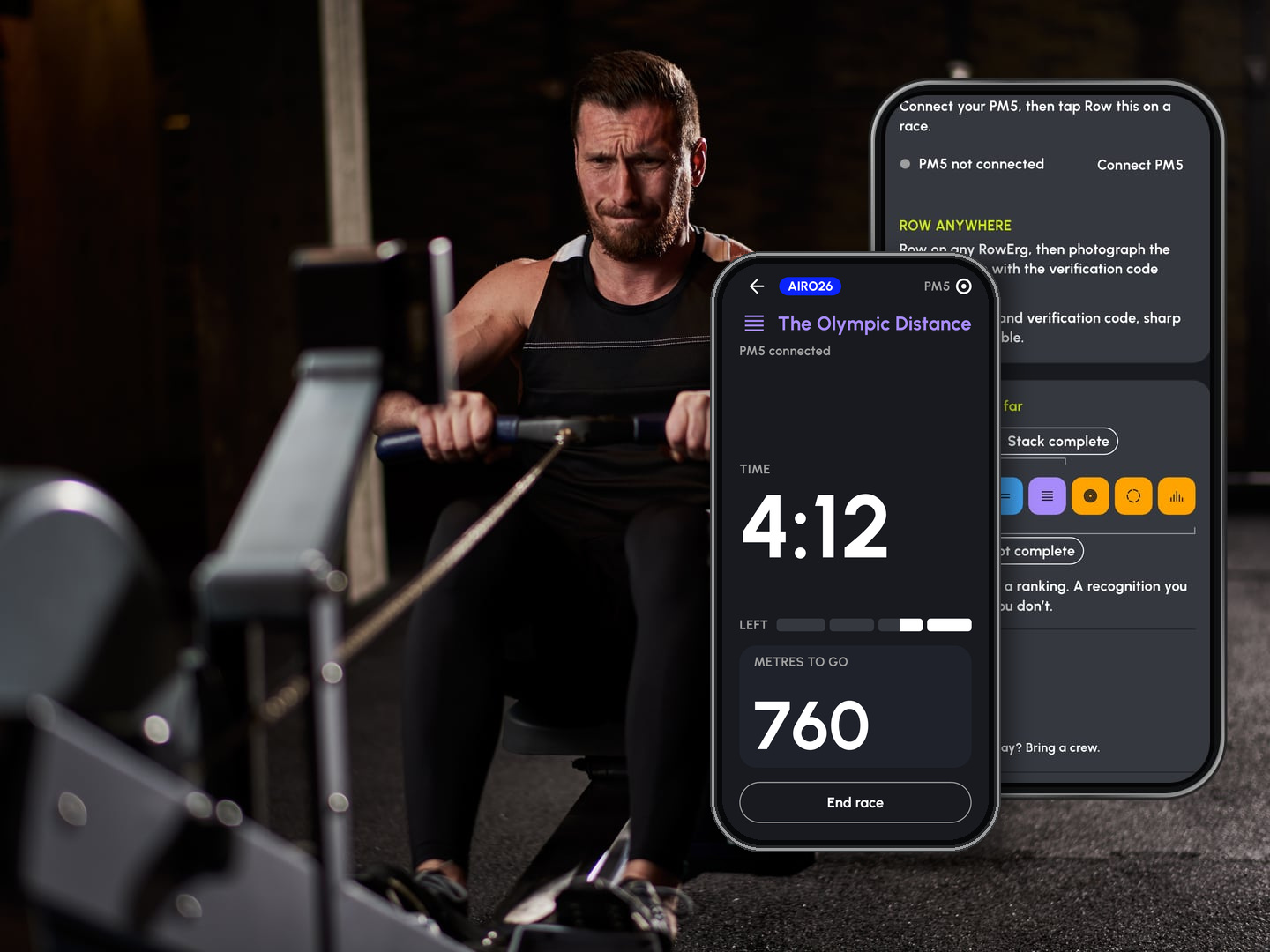
AIRO26: update your app and get ready for 24 October
Get ready for AIRO26 on Saturday 24 October: update the Row Nation app, then read the rules before your first event row.
12 Oct 2026
Nominate your students for the Golden Oar 4x500m RowErg Relay
Every team has one school boy and one school girl, racing 4 x 500 m with Rowing Australia athletes on Saturday 31 October. Nominations close Monday 26 October.